Model Training
import pandas as pd
import numpy as np
import matplotlib.pyplot as plt
import seaborn as sns
from sklearn.preprocessing import StandardScaler
from sklearn.cluster import KMeans
from sklearn.decomposition import PCA
from sklearn.metrics.pairwise import cosine_similarity
from sentence_transformers import SentenceTransformer

# Load the data
huge_data = pd.read_csv('../data/cleaned_600k.csv')
huge_data.drop(columns=['Unnamed: 0'], inplace=True)

final_features = pd.read_csv('../data/final_features_original.csv')
final_features.drop(columns=['Unnamed: 0'], inplace=True)

program_features = pd.read_csv('../data/program_features.csv')
program_features.drop(columns=['Unnamed: 0'], inplace=True)

model = SentenceTransformer('all-MiniLM-L6-V2', device='mps')
/Users/atherv/miniforge3/envs/lifting/lib/python3.13/site-packages/tqdm/auto.py:21: TqdmWarning: IProgress not found. Please update jupyter and ipywidgets. See https://ipywidgets.readthedocs.io/en/stable/user_install.html
from .autonotebook import tqdm as notebook_tqdm
# We need to normalize the features to make sure that the model doesn't get confused by the different scales of the features
scaler = StandardScaler()
final_features_scaled = pd.DataFrame(
    scaler.fit_transform(final_features),
    columns=final_features.columns,
    index=final_features.index
)
kmeans = KMeans(n_clusters=25, random_state=4)
clustering_data = final_features_scaled.copy()
clustering_data['cluster'] = kmeans.fit_predict(clustering_data)
pca = PCA(n_components=2, random_state=4)
reduced = pca.fit_transform(clustering_data)
clustering_data['pca1'], clustering_data['pca2'] = reduced[:, 0], reduced[:,1]
plt.figure(figsize=(14, 7))
palette = sns.color_palette("husl", n_colors=clustering_data['cluster'].nunique())
scatter = sns.scatterplot(
data=clustering_data,
x='pca1',
y='pca2',
hue='cluster',
palette=palette,
s=80,
edgecolor='w',
alpha=0.85,
linewidth=0.8,
legend='full'
)
plt.title('Workout Program Clusters Visualized by PCA (25 Clusters)', fontsize=20, fontweight='bold', pad=20)
plt.xlabel('Principal Component 1 (PCA1)', fontsize=16, labelpad=15)
plt.ylabel('Principal Component 2 (PCA2)', fontsize=16, labelpad=15)
plt.xticks(fontsize=12)
plt.yticks(fontsize=12)
plt.legend(title='Cluster Label', title_fontsize=14, fontsize=12, bbox_to_anchor=(1.05, 1), loc='upper left', borderaxespad=0.)
sns.despine(left=True, bottom=True)
plt.grid(visible=True, linestyle='--', linewidth=0.5, alpha=0.4)
plt.tight_layout()
plt.show()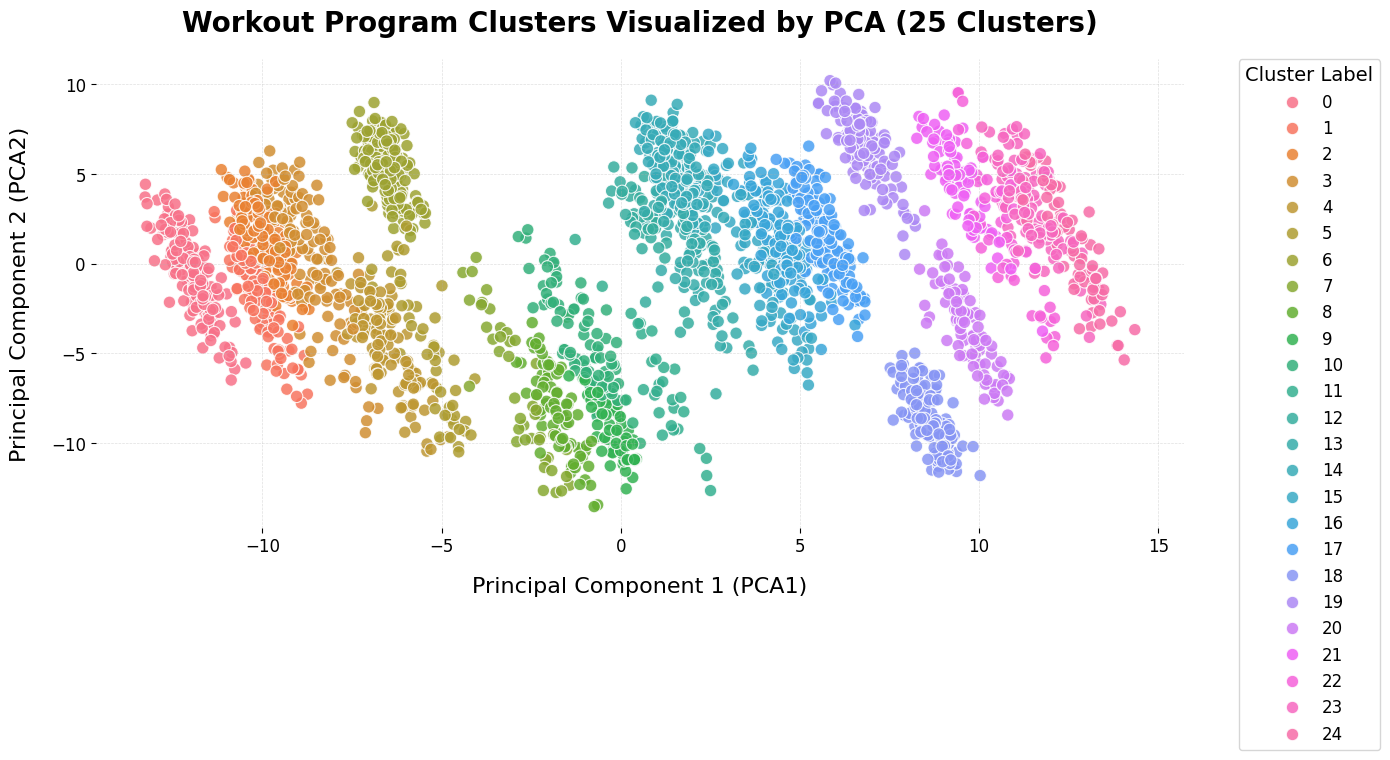
We can’t see the visualize the true groupings of the data, as there are over 400 dimensions. Even so, when using PCA to reduce the dataset down to 2 dimensions, we can see some groups take shape. The embeddings that we are making along with the rest of our features are beginning to clump together.
Model Prediction
similarities = cosine_similarity(clustering_data)def find_top_n(similarity_matrix, n_programs, program, metadata, info, cluster=None, features=None):
"""
Gets the top n workout programs.
Args:
similarity_matrix (np.ndarray): Matrix of similarity scores between programs.
n_programs (int): Number of top similar programs to return.
program (int): Index of the program to compare against.
metadata (list): List of metadata column names to include in the result.
info (list): List of info column names to include in the result.
Returns:
list[pd.DataFrame]: List of DataFrames, each containing the metadata and info for a top similar program.
"""
scores = similarity_matrix[program]
if cluster:
mask = (features['cluster'] == cluster).values
scores = scores * mask
idxs = np.argsort(scores)[::-1]
# Gets the top n indices that aren't itself
top_n = idxs[idxs != program][:n_programs]
top_titles = program_features['title'][top_n]
# For each of the top n workout programs, get out only specific columns and add each DF to a list
progs = [huge_data[huge_data['title'] == i][metadata+info] for i in top_titles]
return progsdef program_recommender(program, features, similarity_matrix, model=model, n_programs=5, within_cluster=False):
"""
Takes in a user's inputted program vector or existing program index
and computes the top n similar workout programs.
Args:
program (int or list): If int, the index of an existing program to use as the query.
If list, a vector of numeric features followed by a string description
representing a custom user program.
features (np.ndarray): Feature matrix of all programs (used for custom queries).
model (SentenceTransformer): Model used to encode text descriptions (default: global model).
n_programs (int): Number of similar programs to return (default: 5).
Returns:
list[pd.DataFrame]: List of DataFrames, each containing metadata and info for a recommended program.
"""
metadata = ['title', 'description', 'level', 'goal', 'equipment', 'program_length','time_per_workout', 'number_of_exercises']
info = ['week', 'day', 'exercise_name', 'sets', 'reps', 'intensity']
if (type(program) == int):
return find_top_n(similarity_matrix,
n_programs,
program,
metadata,
info,
features['cluster'].iloc[program] if within_cluster else None,
features if within_cluster else None
)
elif (type(program) == list):
# Encodes the user's description for the workout
query_embd = model.encode(program[-1])
query_numeric = np.array(program[:-1], dtype=np.float32)
# Concatenate the numeric features and the embedding
query_full = np.concatenate([query_numeric, query_embd.flatten()])
# Standardize the query
scaler = StandardScaler()
features_scaled = scaler.fit_transform(features.drop(columns=['cluster']))
query_full_scaled = (scaler.transform([query_full])[0].reshape(1, -1)) # Reshaping turns the query into a 2D array
cluster = int(kmeans.predict(query_full_scaled))
# Compute cosine similarity between the query and all existing (already scaled) features
similarities_to_query = cosine_similarity(
features_scaled,
query_full_scaled
).flatten()
features_scaled = pd.concat([pd.DataFrame(features_scaled), features['cluster']], axis=1)
return find_top_n(
similarities_to_query.reshape(1, -1),
n_programs,
0,
metadata,
info,
cluster if within_cluster else None,
features_scaled if within_cluster else None
)
else:
raise ValueError('Value inputted is not an int or NumPy array.')"""
Numerical Columns:
'reps_count': Mean reps per rep based exercise
'reps_time': Mean time per time based exercise ,
'is_rep_based': Percentage of rep based exercises (0-1),
'sets': Total number of sets per week,
'reps_per_week': Total number of reps per week,
'program_length': Program length (weeks),
'time_per_workout': Workout length (minutes),
'intensity': Average intensity level across the program (1-10),
OHE Columns:
'level_beginner',
'level_novice',
'level_intermediate',
'level_advanced',
'goal_olympic_weightlifting',
'goal_muscle_&_sculpting',
'goal_bodyweight_fitness',
'goal_powerbuilding',
'goal_bodybuilding',
'goal_powerlifting',
'goal_athletics',
'equipment_at home',
'equipment_dumbbell only',
'equipment_full gym',
'equipment_garage gym'
"""
query = [10,
0,
1,
100,
400,
8,
60,
10,
1,
1,
1,
1,
0,
1,
0,
1,
1,
0,
1,
0,
0,
1,
1,
'Insane Arnold program, not for the weak. You need max intensity in every exercise. Push to failure ALWAYS.']final_features.loc[:, 'cluster'] = clustering_data['cluster']test = program_recommender(query, features=final_features, similarity_matrix=similarities, model=model, within_cluster=True)/Users/atherv/miniforge3/envs/lifting/lib/python3.13/site-packages/sklearn/utils/validation.py:2749: UserWarning: X does not have valid feature names, but StandardScaler was fitted with feature names
warnings.warn(
/Users/atherv/miniforge3/envs/lifting/lib/python3.13/site-packages/sklearn/utils/validation.py:2749: UserWarning: X does not have valid feature names, but KMeans was fitted with feature names
warnings.warn(
/var/folders/cj/mk6_35t16dg3wd3vjv0ymvw00000gn/T/ipykernel_26377/1124979804.py:40: DeprecationWarning: Conversion of an array with ndim > 0 to a scalar is deprecated, and will error in future. Ensure you extract a single element from your array before performing this operation. (Deprecated NumPy 1.25.)
cluster = int(kmeans.predict(query_full_scaled))
for i in range(len(test)):
    title = test[i]['title'].iloc[0]
    description = test[i]['description'].iloc[0]
    print("="*40)
    print(f"Title: {title}\n")
    print(f"Description: {description}")
    print("="*40 + "\n")
========================================
Title: strongman
Description: Strongman

========================================
========================================
Title: high frequent high intensity low volume training
Description: To Build a Foundation
========================================
========================================
Title: end of the year stronger
Description: This program will help you tone your body and maximize each work out to target all of your muscles. This is perfect if you only have 3 days a week to dedicate your work out.
========================================
========================================
Title: mike mentzer's full body routine
Description: This program is designed to build muscle through high-intensity training techniques.
The program is recommended for beginners by Mike Mentzer in his instructional video about Heavy Duty training and is designed secondarily to familiarize the beginner with the basic weightlifting movements. However, Mentzer notes that advanced trainees can benefit from this program as well.
Mentzer recommends a training strategy which is slightly unconventional. Each exercise (with few exceptions) should be taken to momentary muscular failure in all three phases of the movement: the concentric (positive) phase, the contracted (static phase), and the eccentric (negative) phase.
For example, when performing the underhand lat pulldown, the trainee should perform repetitions until he can no longer perform a full contraction. This constitutes positive failure. Then the trainee should use momentum, help from his training partner, or some other form of assistance to perform a full contraction and hold the weight in the contracted position until he can no longer maintain the static, contracted position. This constitutes static failure. Then the trainee should use assistance to perform a full contraction and perform repetitions of the eccentric phase of the exercise under strict control until failure. This constitutes eccentric failure.
The prescribed rep ranges prescribe the number of repetitions it should take the trainee to reach positive failure. After reaching positive failure, the trainee should continue the exercise until both static and negative failure are achieved.
Some exercises cannot be safely taken to static and/or negative failure, such as deadlifts, squats, etc. In these cases, the trainee should end his set after positive failure is reached. Other exercises cannot benefit from the use of momentum to reach full contraction, such as many pressing movements. In these cases, the trainee should only take the set to static or negative failure if he has a training partner or some other way to reach full contraction without using momentum. The most certain way to prevent muscle growth is injury!
========================================
========================================
Title: military prep program
Description: This program is designed to build mass but with an emphasis on building strength in the glutes and quads in preparation of deployment, it includes 4 days focused on hypertrophy and strength, taking many sets to complete failure for mental exhaustion. In addition to this, an additional 2 cardio sessions(cycling) and 2 reformer Pilates sessions a week will be done, each for their own purpose (cardio, and injury prevention) in addition to all of this, I will also be doing grease the groove of 100 pushups and 50 pull-ups a day
========================================
While we are getting back similar-ish programs to our query, they aren’t that close to the ones we want. Based on a huge dataset of user-generated data like the one we have, we would assume that our query would line up with programs that capture more of the meaning. To do this, we can fine-tune our model on our dataset.